
Melodic Gwalior
Gwalior Fort
The most important landmark in the city, Gwalior Fort stands on a steep land of sandstone. This grandeur was built to honour the saint Gwalipa. As per folklore, when the monarch was ill, sage Gwalipa offered him water from a sacred pond to cure him, that is still inside the Gwalior fort complex. The fort has witnessed important incidents, imprisonments, conflicts, and jauhars. Jain tirthankara statues carved into the rock face border the steep road leading up to the fort. The fort’s majestic outside walls, which are two miles long and 35 feet high, continue to remain, attesting to its reputation as one of India’s most impregnable forts. It has been added to the Tentative list of UNESCO World Heritage Sites, highlighting its historical and cultural significance.
Jai Vilas Palace
The Jai Vilas Palace, where the Scindia family currently resides, exhibits the beauty of a royal interior. The Jivaji Rao Scindia Museum is made up of about 25 rooms, and in these regal-styled spaces, the past truly comes to life. The Italianate Jai Vilas building blends Corinthian and Tuscan architectural styles. The two massive central chandeliers in the grand Darbar Hall were only hung after ten elephants tested the stability of the roof. They each weigh several tonnes. The characteristics of these large rooms include gilt-accented ceilings, thick curtains and tapestries, exquisite Persian rugs, and antique furniture from France and Italy.
Teli ka Mandir
Melodic Gwalior
Teli Ka Mandir, a historic religious temple renowned for its Dravidian architecture and intricate artwork, is the tallest building inside the Gwalior Fort complex. As per folk stories, the temple was built with the money donated by oil merchants. Hence, the name Teli Ka Mandir came into existence. Tourists can also find this information in the inscription written on the main gate of the temple. It is about 100 feet tall, and its design combines Hindu and Buddhist elements. The earliest temple in the fort was built either in the eighth or eleventh century. It is dedicated to Lord Vishnu and features constructions within with coiled serpents and river goddesses as well as Lord Vishnu in the guise of his mount, “Garuda.”
Jai Vilas Palace
The 19th-century Moti Mahal, one of the most historic structures in the city, is surrounded by beautiful gardens and fountains. It was originally a Madhya Bharat Government office, but it is currently home to government offices. Highlights of this palace include the wall murals, mosaics, and gorgeous tempera colours that represent Ragas and Raginis.
Sas Bahu Temple
The Sas-Bahu Temple, which is housed inside the Gwalior Fort, consists of two elaborately carved red sandstone temples. Lord Shiva is honoured in the smaller one, while Lord Vishnu is honoured in the larger. Contrary to what the name might imply, this temple is named after Lord Vishnu’s incarnation, Sahastrabahu. In the eleventh century, Kacchapaghata Dynasty King Mahipala built this iconic temple.
Gopachal Parvat
Gopachal Parvat, a well-known series of rock-cut inside the Gwalior Fort, is the best location to view ancient Jain imagery. It is the location of a collection of rock-cut sculptures with carvings from the seventh to the fifteenth centuries. If you’re a history or architectural junky, this place would awe you with its grandeur. Here, the statue of Tirthankaras might be seen standing or sitting during their meditation. For followers of Jainism, it is one of the most significant locations in Gwalior.
Gujari Mahal
The palace was built by King Man Singh for his beloved queen Mrignayani. She was one of the queens of Raja Mansing. King’s love and devotion towards his brave Gujar Queen, Mrignayani, is memorialised in the Gujari Mahal from the fifteenth century.
While the interior of Gujari Mahal has been transformed into an archaeological museum housing rare artefacts, some of which date back to the first century A.D., the exterior building has survived in an almost perfect condition of preservation. Many medieval architectural wonders can be found inside the fort. Their perfection of form has endured the ravages of time, despite the fact that many of these were destroyed by the iconoclastic Mughals. The statue of Shalbhanjika from Gyraspur, the tree goddess and miniature representation of perfection, is very noteworthy. The curator of the museum is in charge of keeping the statue, and visitors may view it upon request.
Sun Temple
Sun Temple, also known as Surya Mandir, is another pride for Gwalior. It was constructed in 1988, and the Sun Temple of Konark served as inspiration for its design. The temple’s red sandstone exteriors make it the ideal location for dawn and sunset photo shooting. White marble was used to carve the statues inside the temple. The temple welcomes a number of visitors and pilgrims every year.
Ghaus Mohammed Tomb
Tansen Tomb
A simple structure of the Tomb of Tansen can be seen a short distance away from the Tomb of Muhammad Ghaus. Tansen was one of the legends and pioneers of Indian classical music and the most famous singer during Akbar’s rule and one among the nine jewels of the court.
Every year in November and December, a grand music event is held at his tomb. Here, musicians and artists from all over the world come to honour the legendary Indian musical maestro Tansen. India-wide performers of both vocal and instrumental music are invited.
Places to visit near Gwalior
Bateshwar Group of Temples
The Bateshwar Hindu Temple is group of temples of roughly 200 sandstone Hindu temples constructed by the Gurjar monarchs in Morena. These temple groups are examples of early Gurjara-Pratihara style temple construction. It is located approximately 30 kilometres (19 miles) from Morena city and about 35 kilometres (22 miles) north of Gwalior. The temples are dispersed over around 25 acres devoted to Shiva, Vishnu, and Shakti, which stand for the three main Hindu religions. Bateshwar temples were constructed between the eighth and tenth centuries.
Padavali
The Jat Ranas of Dhaulpur, who ruled in the 18th century, constructed the renowned Padavali fort. The fort features a temple that was a sacred location to worship Lord Shiva and is graciously guarded by a lion and lioness. Every stone used in the construction of the temple and the fortification has an inscription or other indication of the ancient time period on it!
Mitaoli
The Jat Ranas of Dhaulpur, who ruled in the 18th century, constructed the renowned Padavali fort. The fort features a temple that was a sacred location to worship Lord Shiva and is graciously guarded by a lion and lioness. Every stone used in the construction of the temple and the fortification has an inscription or other indication of the ancient time period on it!
Chanderi Festival: Celebrating an age-old legacy
The sanctuary is perfect for nature lovers and trekkers everywhere, it is located on the Chambal River near the tripoint of Rajasthan, Madhya Pradesh and Uttar Pradesh. The area is designated as sanctuary in order to protect the critically endangered gharial, the red-crowned roof turtle and the endangered Ganges river dolphin. Other large threatened species of the sanctuary include mugger crocodile, striped hyena, Indian wolf and smooth-coated otter. Other reptiles who live in the sanctuary are Indian flapshell turtle, Indian tent turtle, soft shell turtle, monitor lizard and Indian roofed turtle.
Best time to visit Gwalior
Gwalior can be toured throughout the year. However, the summer season is recommended to be avoided if you want to explore the prominent as well as the offbeat places of the city . The best time to visit the city without any hassle and heat wave is in between October to March.
How to reach Gwalior?
By Air
Domestic flights via Air India depart regularly from Gwalior Airport to destinations like Delhi, Mumbai, Indore, and Bhopal. From Delhi’s Indira Gandhi International Airport, which is 335 kilometres away from Gwalior, travellers from other Indian cities and towns as well as from foreign nations can catch a subsequent flight.
By Rail
With direct train connections, Gwalior is well connected to all of India’s main cities. The New Delhi-Bhopal Shatabdi Express takes 3 hours to go from New Delhi to Gwalior. A number of other cities, including Chandigarh, Dehradun, Ahmedabad, Nagpur, Mumbai, Bangalore, Hyderabad, Chennai, Thiruvananthapuram, Kanyakumari, Patna, and Kolkata, are directly connected to this one. Gwalior is a significant railway station that is governed by the Jhansi Rail Division.
By Road
The roads leading to Gwalior are very good in terms of connectivity. All of Madhya Pradesh’s major towns and the surrounding regions are connected to the location. Chanderi is located 239 kilometres, Lucknow and Bhopal are both only 423 kilometres apart, and Delhi is 321 kilometres away.
Best Places to visit
Bateshwar
Gopachal
Gwalior fort
Gujari Mahal
Jai Vilas Palace
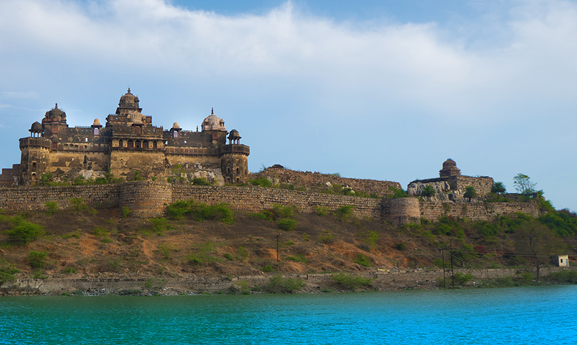
Palatial Datia (76 KM)
An astonishing confluence of Mughal and Rajput architecture, the 7 storeyed Datia Palace stands tall in the historic city of Datia. While its exterior is adorned with arches, chhatris and oriel
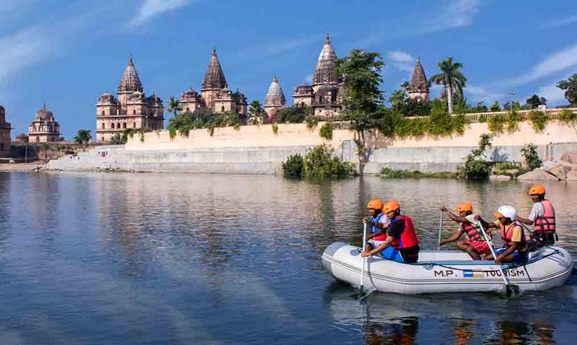
Majestic Orchha (124 KM)
The historic town of Orchha, nestled on the banks of river Betwa, was founded in the 16th century by the Bundela Rajput Chief, Rudra Pratap. Here, the river Betwa splits into seven channels, also